Design & Ideas · June 1, 2026
Dry Creek Beds for Orange County Yards: Drainage Meets Drought-Tolerant Design (2026)
Updated June 1, 2026
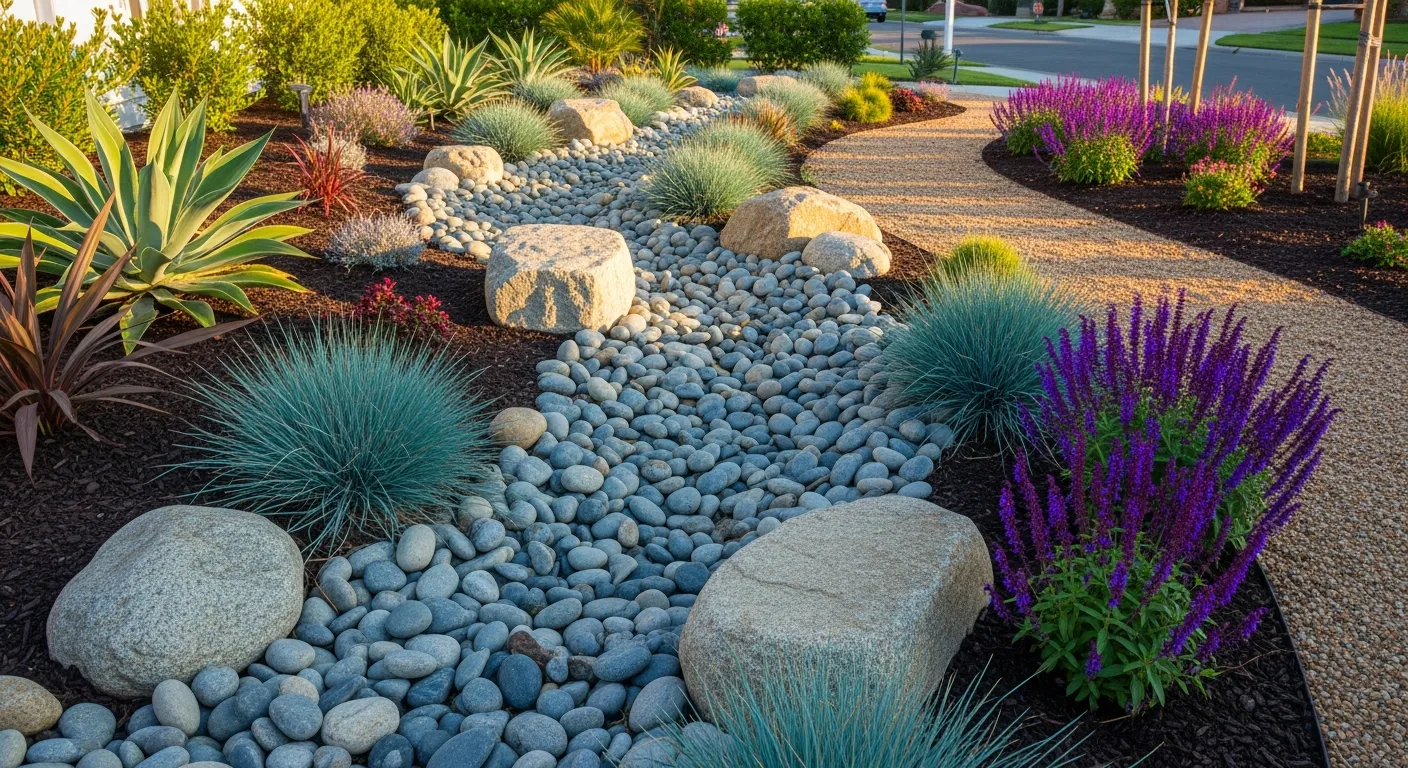
A dry creek bed is the rare landscape feature that solves a real problem and looks beautiful doing it — channeling runoff away from your home while adding a natural, water-wise focal point. Here is how they work, how they are built right, and why they fit Orange County yards so well.
AI-generated audio summary. For the full detail, read on.
What is a dry creek bed?
A dry creek bed is a shallow, rock-lined channel built to look like a natural streambed — a meandering gully of river rock and boulders, edged with drought-tolerant planting. Most of the year it is a sculptural, low-water landscape feature. When it rains, it quietly does its real job: collecting runoff and carrying it safely across your property instead of pooling on the lawn or running toward the house. It is one of the few designs that is genuinely functional and genuinely good-looking at the same time.
Why dry creek beds work so well in Orange County
Our climate is almost tailor-made for them. We get long dry stretches followed by short, intense winter storms — so yards need to handle sudden runoff without staying wet enough to support a pond or bog garden. A dry creek bed manages those storm bursts and then reads as a clean, water-wise design element the rest of the year. It also pairs naturally with the drought-tolerant, Mediterranean planting that already thrives here, which is why we so often design one into a larger water-wise landscape.
Solving drainage and erosion the natural way
If you have a low spot that puddles, a slope that erodes, or downspouts dumping water against the foundation, a dry creek bed is often the most attractive fix. By shaping a defined channel and grading it to fall away from the house toward a safe outlet, it captures and directs water instead of letting it sheet across the yard. On slopes, the rock armoring slows the flow and stops soil from washing away. Done correctly it protects your foundation, your hardscape, and your planting — the same goals as a buried French drain, but as a feature you actually want to look at.
A water-wise look that fits our climate
Aesthetically, a dry creek bed gives a yard movement and a natural focal point without a drop of irrigation. Varied river rock and a few well-placed boulders mimic how water really shapes a streambed, and the planted banks — grasses, agaves, salvias, and California natives — soften the edges and tie it into the landscape. Because the rock is permeable, rain soaks in along the way rather than running straight to the street, keeping more water on your property. It is a centerpiece of the low-water, low-maintenance look more and more Orange County homeowners are after.
How a dry creek bed is built the right way
The difference between a dry creek bed that works for decades and one that washes out in the first storm is all in the build. We map the route to follow the land’s natural fall and end at a safe outlet — never toward the house, a neighbor, or directly into the street. We excavate a channel (a good rule of thumb is roughly twice as wide as it is deep), lay commercial-grade landscape fabric to block weeds and keep rock from sinking into the soil, then layer it: a gravel base, larger river rock and angular boulders along the bottom and banks for stability, and varied stone sizes so it looks natural rather than poured-in-place. Proper grading and rock sizing are what make it both functional and convincing.
Dry creek bed ideas for Orange County yards
A dry creek bed flexes to fit the space. In a front yard, a gentle, meandering bed becomes a curb-appeal centerpiece that replaces thirsty lawn. On a sloped lot, a steeper, boulder-heavy channel doubles as erosion control. A short run can simply carry a downspout to a planting bed, while a longer one can wind the length of a backyard with a timber or flagstone footbridge crossing it. Pair it with uplit specimen boulders, a dry-stack stone border, or a cluster of agaves and ornamental grasses, and it reads as intentional, high-end design — not a drainage afterthought.
Cost, maintenance, and is it right for your yard?
Cost depends mostly on length, the rock and boulders you choose, and how much grading and excavation the site needs — a short downspout run is a modest project, while a long, boulder-rich feature is a larger one. Maintenance is refreshingly light: pull the occasional weed, rinse or top up rock now and then, and clear debris after a big storm. If you have drainage trouble, a slope that erodes, or you simply want a striking low-water feature, a dry creek bed is worth considering. We have designed and built them across Orange County since 1987, and every consultation includes a free, itemized estimate for your property.
Watch & Learn
How to Make a Dry Creek Bed
A clear explainer on the subject.
Frequently asked questions
Do dry creek beds actually work for drainage?
Yes — when they are built correctly. The key is grading the channel so it falls away from the house toward a safe outlet, sizing it for the volume of runoff, and armoring it with the right rock. Built that way, a dry creek bed captures and directs stormwater just like a French drain, while doubling as a landscape feature. Built without proper grading, it is only decorative.
How much does a dry creek bed cost?
It depends on length, the rock and boulders selected, and how much excavation and grading the site needs. A short run to carry a downspout is a modest project; a long, boulder-rich feature across a yard costs more. We provide an itemized estimate after seeing the site so you know exactly what drives the price.
What size rock is best for a dry creek bed?
A natural look comes from mixing sizes: a gravel or small-cobble base, medium river rock through the channel, and larger stones and boulders along the bends and banks to anchor it and control flow. Using a single uniform size is the most common mistake — it looks artificial and washes out more easily.
Do dry creek beds need landscape fabric or a liner?
They need a commercial-grade landscape fabric underneath to suppress weeds and keep the rock from sinking into the soil over time. They do not need a waterproof pond liner — a dry creek bed is meant to let water soak in along its length, which is part of its water-wise benefit.
How do you keep weeds out of a dry creek bed?
A quality fabric base under the rock blocks the vast majority of weeds, and a deep enough rock layer shades out the rest. Any occasional sprouts pull easily from loose rock. Skipping the fabric is what leads to weed problems down the road.
Are dry creek beds low-maintenance and water-wise?
Very. A dry creek bed uses no irrigation, the permeable rock helps rain soak into your property, and upkeep is minimal — occasional weeding, a rinse, and clearing debris after major storms. Paired with drought-tolerant planting on the banks, it is one of the lowest-maintenance, lowest-water features you can add.
Have a project in mind?
Get a free, no-obligation consultation with the All Seasons team.